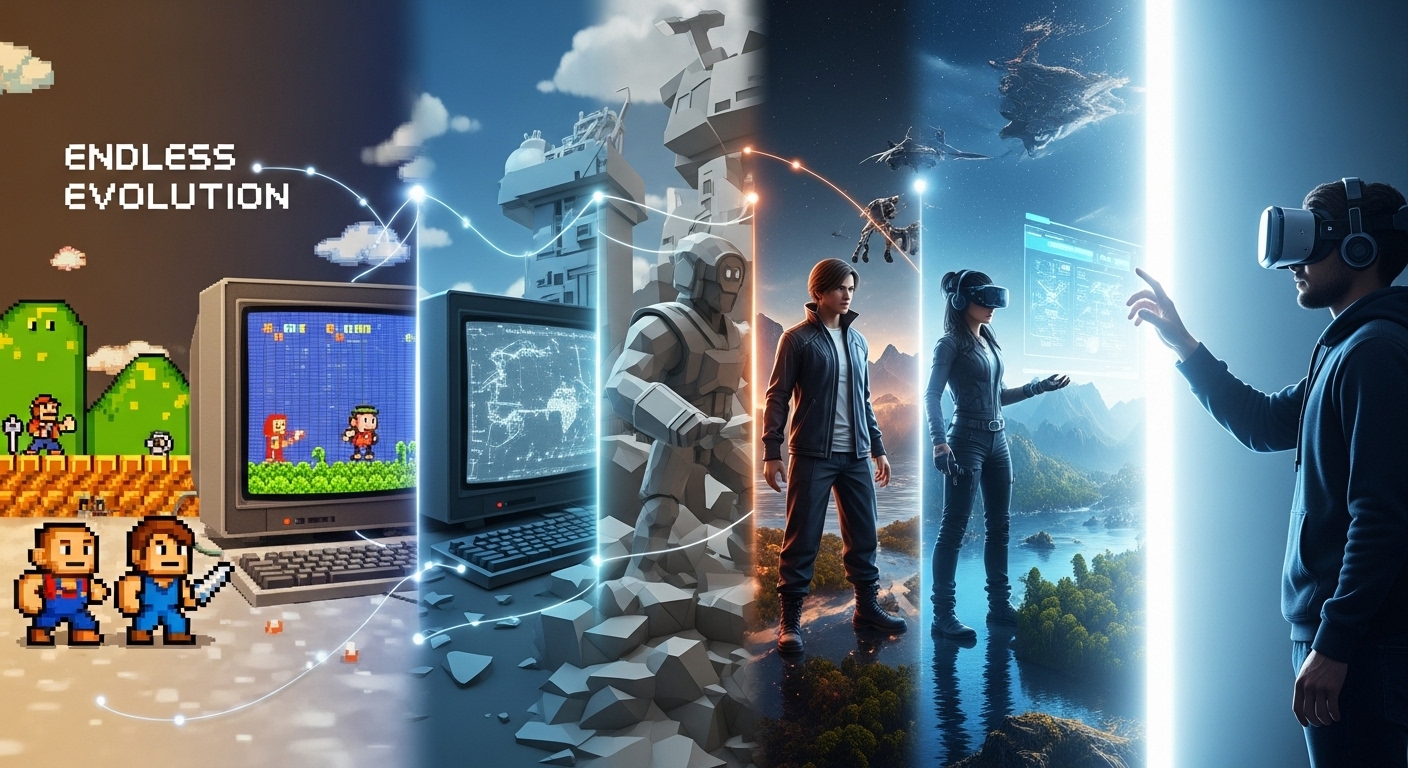






Gaming, once a niche hobby for tech enthusiasts and a form of entertainment for a select group of individuals, has become a global phenomenon. What began in the 1970s with simple arcade games like Pong has transformed into a multi-billion-dollar industry, with immersive, high-fidelity virtual worlds that are almost indistinguishable from reality. In this blog post, we’ll explore the evolution of gaming, from its humble beginnings to the cutting-edge technologies shaping its future.
The Birth of Gaming: The 70s and 80s
In the early days of gaming, the concept of video games was a groundbreaking idea that captured the attention of a small but passionate audience. The first commercially successful arcade game, Pong, created by Atari in 1972, marked the beginning of an era. Simple in design, players controlled paddles on the screen and tried to bounce a ball back and forth—what we now think of as a “retro” game.
The 1980s saw an explosion of arcade machines, from games like Space Invaders and Pac-Man to Donkey Kong and Asteroids. These titles weren’t just games—they were cultural phenomena. People would flock to arcades to play these games, and the competition between players became a defining aspect of the gaming experience. Despite the simplicity of these games by today’s standards, they were revolutionary at the time. For the first time, people could interact with electronic entertainment in real time, creating an entirely new form of leisure.
The Rise of Home Consoles: The 90s and Early 2000s
The 1990s marked a shift from arcades to home gaming. The advent of home consoles, such as the Super Nintendo Entertainment System (SNES), Sega Genesis, and later the Sony PlayStation, brought gaming into people’s living rooms. This period also marked the beginning of 3D graphics and more complex, immersive gameplay.
Super Mario 64, released in 1996 for the Nintendo 64, revolutionized the industry with its fully 3D open-world platforming mechanics. Players could now move Mario freely in all directions, adding a new layer of freedom to the gaming experience. This set the stage for future titles that would feature expansive, 3D environments that felt alive with possibility.
Meanwhile, Sony’s PlayStation consoles brought more mature, cinematic experiences to the table. Games like Final Fantasy VII, Metal Gear Solid, and Gran Turismo demonstrated that video games could be more than just colorful worlds—they could offer intricate plots, emotional depth, and photorealistic graphics, even by the standards of the time.
As graphics improved and games became more complex, gaming began to shift from being a casual pastime to a serious hobby. Games could now tell stories, provoke emotions, and offer players an unparalleled sense of immersion. The late 90s and early 2000s laid the groundwork for the gaming culture that we see today, with gaming conventions, fan communities, and professional tournaments beginning to rise in prominence.
The Online Revolution: MMOs and Online Multiplayer
The real game-changer for the gaming industry came in the form of the internet. In the early 2000s, broadband internet became more widely available, and online gaming quickly followed suit. Massively Multiplayer Online games (MMOs) such as World of Warcraft and EVE Online offered players the opportunity to step into massive, persistent worlds where they could interact with thousands of other players.
MMOs introduced the concept of shared online spaces, where players could form friendships, alliances, and rivalries. These games provided an unprecedented level of immersion, as players were no longer limited by geographical location or time zones. The ability to play with others, whether on the same team or in fierce competition, added a new layer of depth to gaming that had never been seen before.
Online multiplayer games also began to emerge on consoles, most notably Halo 2 for the Xbox, which was one of the first console games to offer a seamless and widely accessible online multiplayer experience. The introduction of online gaming made multiplayer games a core part of the gaming experience, forever changing how players interacted with their favorite titles.
The social element of online gaming is now one of the most powerful forces in the industry. Whether it’s through cooperative experiences like Overwatch or competitive games like Fortnite, gaming has become a social activity in a way it never was before. Players can communicate, team up, and share experiences from across the globe.
The Emergence of Mobile Gaming
While console gaming and PC gaming remained dominant through the 2000s, a new frontier emerged in the form of mobile gaming. The release of the iPhone in 2007 marked the beginning of an explosion in mobile gaming. With its intuitive touchscreen controls and vast app store, mobile devices became the gateway to a massive new audience of gamers.
In the years that followed, mobile gaming grew exponentially, offering everything from simple puzzle games like Candy Crush to immersive role-playing games like Final Fantasy XV: Pocket Edition. The accessibility and affordability of mobile gaming opened up new possibilities for developers and gamers alike. People who had never considered themselves “gamers” were now picking up their phones to play casual games during their commute or while waiting in line.
The mobile gaming industry also introduced free-to-play models, with games like Clash of Clans and Pokémon GO leveraging in-app purchases and microtransactions to generate revenue. While some of these practices have sparked controversy, mobile games have undeniably democratized access to gaming, reaching new players who may never have picked up a console or PC.
Virtual Reality and Augmented Reality: The Next Frontier
As technology continued to evolve, the next step in gaming’s progression seemed inevitable—Virtual Reality (VR). With companies like Oculus, HTC Vive, and PlayStation VR, immersive gaming experiences became available to the general public. VR technology allows players to step into fully realized worlds, offering a level of immersion that was once the stuff of science fiction.
While VR gaming has not yet reached the level of mainstream adoption that traditional gaming has enjoyed, it holds incredible promise. Titles like Beat Saber and Half-Life: Alyx show the immense potential of VR to create experiences that are not possible with traditional screens. The ability to interact with virtual environments in such a direct, physical way has created a new genre of gaming experiences that are pushing the boundaries of what is possible.
In addition to VR, Augmented Reality (AR) has also gained traction, most famously with Pokémon GO. AR blends the real world with virtual elements, allowing players to see and interact with digital objects overlaid on their physical surroundings. AR’s potential in gaming could reshape the way we play games, from bringing game characters to life in the real world to enabling new types of social experiences.
The Future of Gaming: Artificial Intelligence and Beyond
As we look toward the future, the possibilities for gaming seem limitless. One of the most exciting developments on the horizon is the integration of Artificial Intelligence (AI) into gaming. Already, AI is used to control non-player characters (NPCs), but future advancements could enable AI to generate entire game worlds on the fly, adapt to player behavior, and create unique narratives based on individual choices.
Imagine playing a game where the story adapts to your actions in real time, where NPCs remember past interactions, and where no two playthroughs are the same. With advancements in machine learning, such experiences could become a reality.
Additionally, the rise of cloud gaming—where games are streamed over the internet rather than run on local hardware—could revolutionize how we access and play games. Services like Google Stadia, Xbox Cloud Gaming, and NVIDIA GeForce Now are already pushing this technology forward, offering players access to high-quality games without the need for powerful hardware. This could make gaming more accessible to a broader audience and further blur the lines between different types of gaming platforms.
Conclusion: A New Era of Gaming
From humble beginnings in the arcades to the rise of home consoles, online multiplayer, mobile gaming, and virtual reality, the journey of video games has been nothing short of extraordinary. What started as a niche hobby has evolved into a dominant form of entertainment enjoyed by millions of people worldwide.
As technology continues to advance, gaming will only grow more immersive, interactive, and innovative. With the potential of AI, cloud gaming, and VR, we are on the cusp of a new era in gaming, one that could redefine entertainment as we know it. Whether you’re a hardcore gamer or someone who enjoys the occasional mobile game, there’s no denying the impact gaming has had—and will continue to have—on our lives.
Gaming isn’t just a pastime anymore; it’s a cultural force that brings people together, tells stories, and challenges the very limits of creativity. As the industry continues to evolve, one thing is clear: the future of gaming is bound to be even more exciting than the past.