





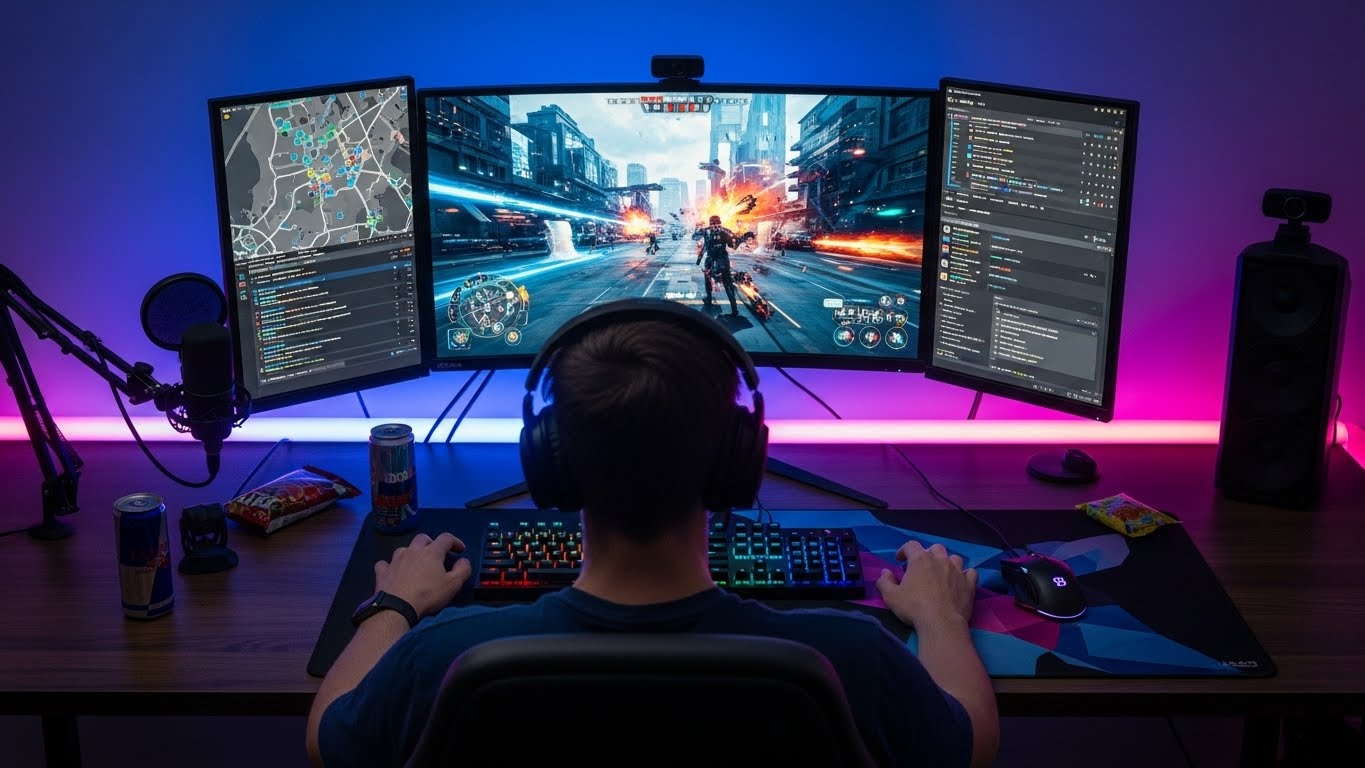
Gaming, once a niche activity primarily enjoyed by enthusiasts and young hobbyists, has become a multi-billion-dollar industry that is part of mainstream culture. It has transcended its early roots of arcade machines and home consoles to become an expansive form of entertainment that encompasses everything from casual mobile games to expansive, immersive worlds in virtual reality (VR). In this blog post, we will explore the fascinating evolution of gaming, its various genres, the role it plays in society, and its future in a world of rapidly advancing technology.
The Birth of Gaming: Early Beginnings
The roots of modern gaming can be traced back to the 1950s and 1960s when the first computer-based games were developed. These early games were very rudimentary, relying on basic graphics and text. One of the earliest known video games, “Tennis for Two,” was developed by physicist William Higinbotham in 1958 as a demonstration on an oscilloscope. It allowed two players to control paddles and hit a ball back and forth, a concept that would later inspire the creation of “Pong,” one of the first commercially successful video games.
In the early 1970s, arcade machines became popular, and “Pong” was released by Atari, marking the birth of the video game industry. The success of arcade games led to the development of home consoles. The first home gaming system, the Magnavox Odyssey, was introduced in 1972. While the graphics were minimal and the gameplay simple, it laid the groundwork for future home gaming systems.
The Golden Age of Video Games
The late 1970s and 1980s saw the rise of more sophisticated arcade games, and this period is often referred to as the Golden Age of Video Games. Titles like “Space Invaders”, “Asteroids”, and “Pac-Man” became cultural icons. These games introduced the idea of high scores and competition, fueling the gaming boom. Home consoles also evolved during this time, with systems like the Atari 2600 and the Nintendo Entertainment System (NES) becoming household names.
The rise of gaming culture also brought about the first wave of gaming communities, where players would swap tips, tricks, and strategies in arcades or through early gaming magazines. These communities were the precursors to the global gaming networks we see today.
However, the industry also faced a major setback in the mid-1980s with what is known as the video game crash of 1983. Oversaturation of low-quality games and the failure of major companies like Atari to adapt led to a downturn. But just as the industry seemed to falter, Nintendo revolutionized the gaming world with the release of the NES in 1985, reinvigorating the market and introducing timeless franchises like Super Mario and The Legend of Zelda.
The 3D Revolution and Console Wars
The 1990s marked a significant leap in the gaming world, thanks to technological advances in hardware and graphics. The introduction of 3D graphics was a game-changer, bringing more depth and realism to virtual worlds. The Sony PlayStation (1994) and Sega Saturn (1994) ushered in a new era of gaming with more complex, 3D environments.
During this period, “Super Mario 64” became one of the first truly groundbreaking 3D games, taking players into a fully three-dimensional world with innovative controls. Similarly, “Final Fantasy VII” was a revolutionary role-playing game (RPG) that pushed narrative storytelling to new heights, with cinematic cutscenes and intricate plots.
The ’90s also gave rise to what is known as the console wars, with companies like Nintendo, Sony, and Sega battling for dominance in the market. The rivalry between Nintendo’s Super Nintendo Entertainment System (SNES) and Sega’s Genesis escalated further with the release of newer systems like Sony’s PlayStation and Sega’s Dreamcast. These battles were not only about hardware, but also about exclusive games, brand loyalty, and defining the future of gaming.
The Rise of Online Multiplayer Gaming
As the internet became more accessible in the late ’90s and early 2000s, multiplayer gaming evolved from local co-op play to massive online experiences. “Diablo II” (2000) and “StarCraft” (1998) were early pioneers in online multiplayer gaming, bringing players together over the internet to experience cooperative and competitive play.
By the early 2000s, MMORPGs (Massively Multiplayer Online Role-Playing Games) like “World of Warcraft” (2004) and “Guild Wars” (2005) took the gaming world by storm. These games allowed thousands of players to interact in expansive virtual worlds, creating their own characters, quests, and stories. “Halo 2” (2004) revolutionized console multiplayer gaming, introducing the world to online matchmaking and voice communication in first-person shooters.
This era marked the beginning of the online gaming culture we are familiar with today, where gamers from around the world could come together to form communities, engage in tournaments, and experience games in a social environment.
The Mobile Gaming Boom
In the late 2000s, mobile gaming began to emerge as a force to be reckoned with, thanks to the proliferation of smartphones and app stores. Games like “Angry Birds” (2009) and “Candy Crush Saga” (2012) became global phenomena, attracting millions of players across all demographics. Unlike traditional gaming consoles, mobile games are incredibly accessible, requiring only a smartphone or tablet to play.
The mobile gaming market exploded, and companies like Supercell, King, and Niantic capitalized on this trend, creating games that reached a mass audience. “Pokémon GO” (2016), an augmented reality (AR) game, became a cultural milestone, blending mobile gaming with real-world exploration and social interaction.
Mobile games have continued to grow in popularity, with titles spanning across a wide range of genres from puzzle games to battle royales. As smartphones became more powerful, the complexity and quality of mobile games improved, narrowing the gap between console and mobile gaming experiences.
Virtual Reality and the Future of Gaming
In the last decade, virtual reality (VR) and augmented reality (AR) have opened up new horizons for gaming. VR headsets like Oculus Rift and HTC Vive have allowed players to step into immersive, fully interactive worlds. Games like “Beat Saber”, “Half-Life: Alyx”, and “The Walking Dead: Saints & Sinners” have demonstrated the potential of VR, offering a completely new way to experience video games.
The future of gaming is not just about improving graphics or creating bigger worlds; it’s about creating more immersive and interactive experiences. VR and AR technologies promise to take gaming to the next level, allowing players to physically interact with their environments and influence the outcomes of their gameplay in ways that were previously impossible.
One of the exciting prospects of VR gaming is the potential for social VR spaces, where players can interact with others in virtual worlds. Companies like Meta (formerly Facebook) are investing heavily in the metaverse, envisioning a future where games are integrated with virtual environments, creating entirely new forms of social interaction and entertainment.
The Influence of Streaming and eSports
As gaming becomes more mainstream, it has also become an increasingly popular form of content creation. Platforms like Twitch and YouTube Gaming allow players to stream their gameplay to millions of viewers, creating an entirely new category of entertainment. Professional gamers and streamers have become celebrities in their own right, building massive followings and earning millions of dollars in sponsorships, ads, and donations.
eSports, or competitive gaming, has grown exponentially, with professional players competing in tournaments for massive prize pools. Games like “League of Legends”, “Dota 2”, and “Fortnite” have helped solidify gaming as a spectator sport, drawing in audiences that rival traditional sports events. The growing popularity of eSports has led to the creation of professional leagues, college scholarships, and even recognition at the Olympic level.
Gaming and Its Cultural Impact
Gaming has evolved beyond entertainment to become a significant cultural force. The characters, stories, and worlds created in video games have influenced other forms of media, from films and television to books and comics. Franchises like “The Legend of Zelda”, “Final Fantasy”, and “The Elder Scrolls” have transcended the gaming world, becoming part of global pop culture.
Moreover, video games have become a platform for storytelling, allowing developers to craft rich narratives and emotional experiences. Games like “The Last of Us”, “Red Dead Redemption 2”, and “Journey” have proven that video games can be as powerful a medium for storytelling as films or literature. This evolution has led to the recognition of gaming as an art form.
The Future of Gaming
As technology continues to advance, the future of gaming looks incredibly promising. Artificial Intelligence (AI) will likely play a significant role in shaping the way games are created and played. Games may become more personalized, adapting to players’ choices and actions in real-time. Additionally, the rise of cloud gaming means that high-quality gaming experiences can be streamed directly to any device, eliminating the need for expensive hardware.
Virtual reality, augmented reality, and the metaverse are also poised to revolutionize the way we interact with games. The potential for fully immersive, multi-sensory experiences could redefine what it means to play a game. Whether it’s through photorealistic graphics, advanced haptic feedback, or AI